

This article contains affiliate links to the companies reviewed below. If you click a link and open or fund a Precious Metals IRA, we may earn a commission at no extra cost to you. We only partner with reputable providers we’ve vetted through industry rankings, customer data, and real investor feedback. All opinions are our own.
Gold IRA Rollover Services Review

The not-so-simple but actually pretty straightforward option I’ve been researching for moving retirement savings into physical gold is a gold IRA rollover service. After watching my traditional IRA take hits every time the Fed announces rate changes or inflation numbers come out worse than expected, I started looking into this seriously.
A gold IRA rollover lets you transfer money from your existing 401(k), 403(b), traditional IRA, or similar retirement account into a self-directed IRA that holds actual physical precious metals. The metals sit in a vault somewhere instead of being tied to stock market performance or bond yields.
You work with a gold IRA company that coordinates everything with your current custodian so you don’t trigger taxes or early withdrawal penalties.
The reason this caught my attention is simple. Traditional retirement accounts live and die by market performance.
When inflation picks up steam, those accounts can lose buying power fast.
Physical gold historically holds its value during those periods, which matters when you’re trying to protect what you’ve already saved.
Why People Actually Choose Gold IRAs

I’m not going to pretend gold IRAs are some magic solution for everyone. They’re not.
But for people who’ve watched their retirement accounts swing wildly with every market correction, the appeal is pretty obvious. Stocks and bonds respond to corporate earnings, Fed policy, political drama, and a thousand other factors.
Gold doesn’t care about any of that.
When inflation runs hot, gold tends to maintain purchasing power. It’s not about getting rich quick.
It’s about preserving what you’ve already earned over decades of working and saving.
The other thing that matters here is control. With a self-directed IRA, you choose the specific metals, the custodian holding the account, and the depository storing everything.
You’re not stuck with whatever mutual funds some brokerage decides to offer you.
That level of autonomy appeals to people who’ve spent their careers making their own financial decisions and don’t want to hand over control to someone else now.
How the Rollover Process Actually Works
The mechanics of a gold IRA rollover follow specific IRS rules to keep everything tax-deferred.
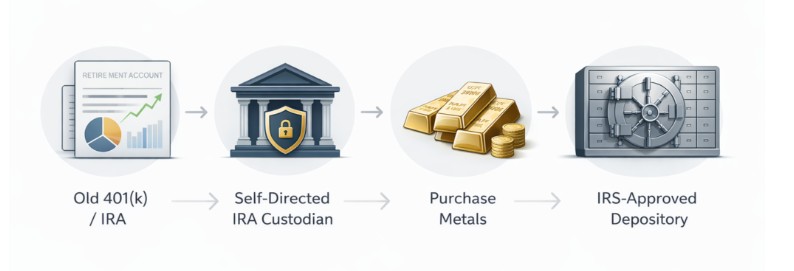
Your gold IRA company doesn’t directly touch your money. They coordinate with your current custodian (whoever holds your old 401(k) or IRA) to transfer funds directly to a new custodian that specializes in self-directed precious metals IRAs.
This direct custodian-to-custodian transfer keeps everything in tax-deferred status. You don’t report it as income.
There’s no 60-day deadline hanging over your head like there is with indirect rollovers, where you actually receive the money first.
Once the funds land at your new custodian, you purchase IRS-approved precious metals and have them stored in an IRS-compliant depository. The timeline varies by company, but account setup usually takes around 30 minutes for the paperwork part.
The actual transfer can take several business days, depending on how fast your old provider processes everything.
Best Gold IRA Companies (Based on What I Found)

I spent way too much time reading gold ira rollover service reviews and comparing companies. Here’s what actually stood out.
Augusta Precious Metals ranks highest across pretty much every review platform I checked. They need a $50,000 least investment, which is steep, but they deliver solid guidance through the whole rollover process.
Their fees are transparent at $200-$250 annually, and customer support is apparently excellent based on their 4.98 rating across over 1,400 reviews.
The high least means Augusta isn’t for everyone, but if you’re moving a significant chunk of retirement savings and want professional handling, they’re worth looking at.
Goldco works well for beginners and 401(k) rollovers specifically. They have a $25,000 least and an A+ Better Business Bureau rating.
Goldco doesn’t charge setup fees itself, though the custodian they work with (Equity Trust) charges around $50 setup and $80-$100 annually, plus storage fees of $100-$150.
Their Trustpilot rating sits at 4.95 across nearly 7,000 reviews, which is a lot of feedback to sort through. The volume of reviews matters because it’s harder to fake that many real customer experiences.
American Hartford Gold attracts people focused on keeping costs down. They accept IRAs starting at $10,000 and partner with both Equity Trust Company and STRATA Trust, so you can pick your preferred custodian.
They maintain an A+ BBB rating and strong Trustpilot scores (4.6 out of 5 across 1,600+ reviews).
The lower limit makes them accessible if you’re not ready to move $50,000 into metals but want to get started with a smaller allocation.
Advantage Gold emphasizes education and has strong customer ratings. Founded in 2014, they’ve built up 1,780 five-star reviews on TrustPilot (98% of their total reviews).
They offer many custodian and depository options and sell gold, silver, platinum, and palladium.
The downside is they don’t publicly list the least purchase amounts, so you have to call them to talk about specifics.
Lear Capital ranks high for flexible investment options and educational resources. They offer personalized investment plans and useful tools like RMD calculators and rollover guides specifically designed for precious metals IRAs.
Here’s a quick comparison table I put together:
| Company | Best For | Minimum | Annual Fees | Rating |
|---|---|---|---|---|
| Augusta Precious Metals | Overall quality | $50,000 | $200-$250 | 4.98★ |
| Goldco | Beginners/401(k)s | $25,000 | $200-$280 | 4.95★ |
| American Hartford Gold | Low fees | $10,000 | $150-$180 | 4.75★ |
| Advantage Gold | Education focus | Not disclosed | Variable | 4.8★ |
| Lear Capital | Flexible options | $5,000-$10,000 | Variable | 4.9★+ |
The Real Costs (This Is Where It Gets Tricky)
Reading through gold IRA rollover service reviews, one thing became clear pretty fast. The fee structure confuses almost everyone at first.
Gold IRA companies often quote their own fees, which might be zero or minimal. Then you explore the actual costs buried in custodian and storage fees that are separate.
Here’s what a typical breakdown looks like:
Your custodian (the company legally holding your IRA) charges setup fees of $50-$100 and annual maintenance fees of $75-$150. Separate from that, the depository storing your physical metals charges storage fees of $100-$300 annually, depending on whether you choose segregated or unsegregated storage.
Goldco, for example, doesn’t charge fees directly. But the custodian they recommend (Equity Trust) charges a $50 setup and $80 annual maintenance, plus $100-$150 for storage.
You’re still paying those fees; they’re just not going to Goldco.
American Hartford Gold is genuinely transparent about keeping costs down and avoiding the heavy markups that plague other companies.
Segregated storage means your metals are stored separately from other customers’ holdings. Unsegregated storage means your metals are mixed together with others (though you still own a specific amount).
Segregated costs more but provides extra security and peace of mind.
For most people, unsegregated storage is standard and enough.
The companies with the strongest reputations have moved toward pricing transparency after complaints about hidden markups. This shift alone tells you which companies to trust.
IRS Rules You Can’t Ignore
The IRS has specific requirements for precious metals IRAs. Violations can result in your entire account being disqualified, meaning you’d owe taxes on everything plus penalties.
Fineness requirements matter a lot. Gold must be at least 99.5% pure, silver 99.9%, platinum and palladium 99.95%.
This rules out rare coins or collectible gold items.
You can only hold bullion and government-minted coins that meet purity standards.
Storage rules are non-negotiable. Your metals must be stored in an IRS-approved depository.
You cannot keep them at home.
Some companies offer non-IRA home delivery, where you physically store metals yourself, but that’s a completely different account type with different tax treatment.
Custodian requirement trips people up initially. You must use an IRS-approved custodian.
The company you call (like Goldco or Augusta) is the dealer, not the custodian.
The custodian is a separate firm that legally holds the account and ensures IRS compliance. The dealer guides the process and helps you choose metals.
The custodian oversees tax compliance and holds the account.
Understanding this distinction matters when you’re evaluating gold IRA rollover service reviews and trying to figure out who does what.
Companies like Equity Trust and STRATA Trust are major custodians in this space and work with many dealers.
Red Flags to Watch For
The industry has enough sketchy operators that recognizing warning signs matters.
Companies using high-pressure sales tactics should be avoided. Same with companies refusing to quote fees upfront, pushing rare or collectible coins heavily, or making promises about gold prices moving in guaranteed directions.
Established companies with A+ Better Business Bureau ratings, thousands of verified customer reviews, and consistent messaging across many platforms have earned that reputation through years of honest dealing.
The rating difference between a 4.9-star company with 6,000+ reviews and a 3.0-star company with 1,600 reviews reflects widespread customer experience. That’s not a minor difference.
Check whether their customer service team actually answers questions about fees and minimums without requiring a phone call first.
Transparency about costs separates trustworthy operators from those hiding pricing until you’re deep in the sales process.
How Much Should You Actually Put In
Minimum investment requirements range from $5,000 to $50,000, depending on the company.
If you have $100,000+ in a 401(k) and want to partially hedge with precious metals, a $25,000-$50,000 allocation makes sense. If you have a smaller retirement account, a company accepting $5,000-$10,000 minimums provides more flexibility without requiring you to move your entire retirement into metals.
Most financial advisors recommend that precious metals represent 5-15% of a diversified retirement portfolio. That’s enough to provide inflation protection without overexposing yourself to metals volatility.
Someone with $200,000 in retirement savings putting $30,000-$40,000 into a gold IRA is making a measured decision. Someone betting their entire retirement on metal prices is taking unnecessary risk.
The goal is hedging against inflation and market volatility, not replacing your entire retirement strategy.
Getting Started With a Gold IRA Rollover
If you’re ready to explore whether a gold IRA rollover makes sense for your situation, start with companies that have consistently earned high ratings and transparent operations.
Check out Augusta Precious Metals if you’re moving $50,000 or more. Their professional guidance through the rollover process removes confusion and guesswork.
The high least keeps out casual investors, but if you’re serious about moving a significant portion of your retirement savings, they handle it well.
Look into Goldco’s 401(k) rollover process if you’re specifically rolling over a 401(k). Their specialists walk through every step, and the $25,000 least is more accessible than Augusta while still maintaining quality service.
Consider American Hartford Gold if fees are your primary concern. When you’re comfortable with a $10,000 least and want transparent pricing that eliminates surprises, they’re worth contacting.
Before committing to any company, ask a written fee schedule. Ask about both their fees and the custodian’s fees.
The total cost matters, not just one piece of it.
Request references or check independent review sites like TrustPilot and ConsumerAffairs to see what actual customers experienced. Reading through many gold ira rollover service reviews gives you a clearer picture than relying on company marketing materials alone.
What I Actually Think About All This
After going through dozens of gold IRA rollover service reviews and comparing companies, here’s my honest take.
Gold IRAs make sense as part of a diversified retirement strategy. They don’t make sense as your entire retirement strategy.
The companies worth working with are transparent about fees, don’t use high-pressure sales tactics, have thousands of verified customer reviews, and partner with reputable custodians like Equity Trust or STRATA Trust.
Augusta Precious Metals, Goldco, and American Hartford Gold consistently show up at the top of legitimate reviews for good reason. They’ve earned those ratings through years of honest dealing and actual customer service.
The least investment requirements vary enough that you can find something that fits your situation. If you have $50,000 or more to move, Augusta’s higher least comes with correspondingly higher service quality.
If you’re starting with $10,000-$25,000, American Hartford Gold or Goldco provides solid options.
The IRS rules around purity, storage, and custodians are strict but straightforward once you understand them. Working with an established company means they walk you through those requirements so you don’t accidentally violate something and trigger tax penalties.
The fee structure takes some effort to understand fully, but companies that are transparent about custodian fees, storage fees, and their own fees make it easier to compare total costs.
Get a free information kit from one of the top-rated companies if you want to explore this further. Most of them will send you detailed information without requiring you to sit through a sales pitch first.
The gold IRA rollover process works well as an inflation hedge and portfolio diversification tool when you work with reputable companies and maintain realistic expectations about what precious metals can and can’t do for your retirement savings.